
Patient Care Assistant Certificate Options in Cape Coral
Earn a Nursing Assistant/Aide and Patient Care Assistant/Aide Certificate in 12 weeks to under a year in person at Cape Coral Technical College, gaining hands-on skills for immediate healthcare jobs.

By Diana Tillotson
If you want to enter the healthcare field quickly, the Nursing Assistant/Aide and Patient Care Assistant/Aide Certificate, 12 weeks to less than 1 year In-person at Cape Coral Technical College is a direct route. This program trains you for two closely related roles, so you graduate with more flexibility when applying to hospitals, long-term care facilities, and home health agencies in Southwest Florida. The demand for nursing aides and patient care assistants remains steady, and completing a recognized certificate locally can help you build patient care skills faster than a traditional degree path. Below, we break down what the training covers, why it matters for your job search, and how you can take the next step in your healthcare career.
Understanding the Nursing Assistant and Patient Care Assistant Dual Certificate
The program at Cape Coral Technical College combines the core curriculum for a Nursing Assistant/Aide with the expanded scope of a Patient Care Assistant/Aide. In plain terms, you get two marketable credentials in one training sequence. The typical timeline runs from 12 weeks to less than one year, which means you can move from the classroom to clinical practice in a matter of months rather than years. Most students complete the didactic portion at the college campus, then practice skills in a supervised lab before heading to a clinical rotation at an affiliated facility.
Because the certificate is earned in person, you benefit from direct instructor feedback and hands-on practice every single session. You learn how to measure vital signs, transfer patients safely, document care, and communicate with nurses and families. The patient care assistant component often adds training in phlebotomy, EKG monitoring, or basic rehabilitation techniques, depending on the local curriculum. This broader skill set makes you a stronger candidate for entry-level positions that require more than just the standard CNA credential.
Why Choose an In-Person Training Format?
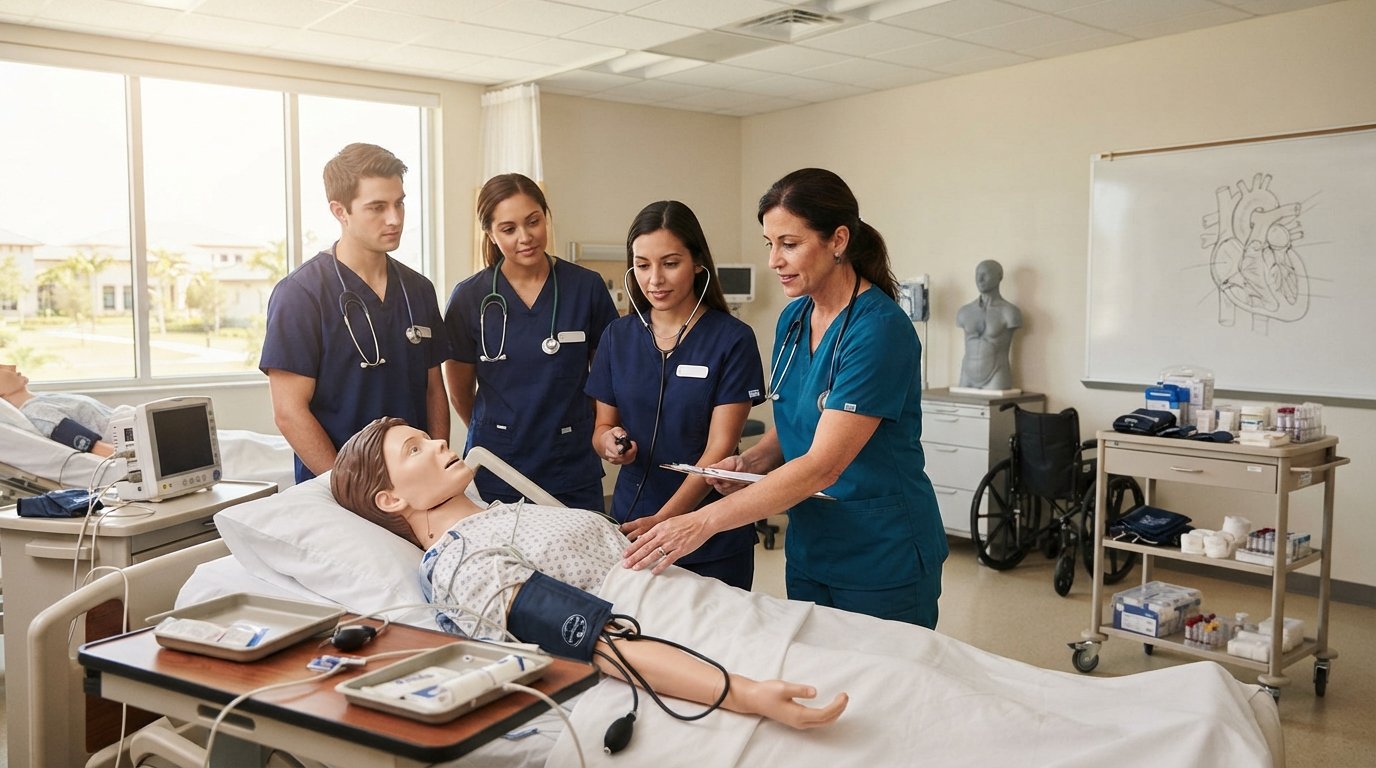
Some students wonder whether they should take an online CNA course instead. However, nursing assistant and patient care assistant roles are inherently physical. You cannot learn proper body mechanics, sterile technique, or patient transfers solely from a video. The in-person format at Cape Coral Technical College ensures you practice on mannequins and volunteer classmates before you ever touch a real patient. Your instructor can correct your hand placement, your gait belt technique, and your communication style in the moment, which reduces the chance of bad habits forming.
In-person training also builds your professional network. Your clinical site becomes a potential job leads, and your instructors often have direct relationships with local employers. When you train alongside other students who share your career goals, you gain study partners and future colleagues who understand the specific challenges of working in Southwest Florida healthcare settings. That community support can make the difference between finishing the program and stopping halfway.
What You Will Learn in the Classroom and Lab
The curriculum usually begins with medical terminology, infection control, and legal and ethical responsibilities. From there, you move into the core nursing assistant skills: bathing, dressing, feeding, and toileting patients who need full assistance. You also learn how to measure and record blood pressure, pulse, respiration, temperature, and pain levels. The patient care assistant portion often adds modules on basic cardiac monitoring, blood glucose testing, and oxygen administration, which are valuable in clinics and hospital units.
Your lab sessions will mirror a real hospital room. You will practice making occupied beds, using a mechanical lift, and responding to emergency call lights. Many programs also require certification in cardiopulmonary resuscitation (CPR) for healthcare providers, so you leave with that credential as well. By the final weeks, you will feel confident walking into a patient room on your own, introducing yourself, and performing a full set of vitals without hesitation.
Career Opportunities After Graduation
Graduates of the Nursing Assistant/Aide and Patient Care Assistant/Aide Certificate, 12 weeks to less than 1 year In-person at Cape Coral Technical College can pursue several entry-level titles. The most common job is a Certified Nursing Assistant (CNA), but with the patient care assistant training, you may also qualify for roles such as Patient Care Technician (PCT), Hospital Aide, or Home Health Aide. Hospitals, skilled nursing facilities, assisted living residences, and home care agencies all hire from these certificate programs on a regular basis.
Beyond the immediate job search, this certificate can be a stepping stone to further education. Many licensed practical nurses (LPNs) and registered nurses (RNs) started as CNAs or patient care technicians. The hands-on experience you gain helps you decide whether direct patient care is your true passion, and it gives you a financial base while you pursue a higher degree. Some students use their CNA hours as a prerequisite for LPN bridge programs, so this short certificate never limits your future potential.
If you are considering a broader career trajectory, you might want to explore how trade certificate programs with high job placement rates align with your goals. That guide explains how to evaluate different training options and choose one that sets you up for employment right after graduation.
How to Enroll and What You Need to Get Started
Enrollment at Cape Coral Technical College typically requires a high school diploma or GED, a completed application, and a background check. Some programs also ask for proof of immunizations and a physical exam before you can begin clinical rotations. Because the program fills up quickly, you should apply at least a few weeks before the term starts. The college financial aid office can help you access federal grants, state scholarships, or workforce development funds that cover tuition and supplies.
Before you apply, consider whether you can commit to the full schedule. Most in-person healthcare certificate programs run Monday through Friday during the day, although some offer evening or weekend cohorts. If you have a job or family obligations, look for a part-time track that stretches the course length toward the one-year mark. The flexibility of a 12-week versus a 12-month timeline means you can choose a pace that matches your life.
Financial Aid and Free Training Options
Healthcare training programs are often eligible for federal financial aid, and if you qualify for a Pell Grant, you might not need to pay anything upfront. Florida residents may also access the Workforce Innovation and Opportunity Act (WIOA) funds if you are dislocated or underemployed. Some local hospitals offer tuition reimbursement for employees who agree to work for them for a certain period after certification, so it is worth asking about that at your clinical site.
Do not let the cost of the program stop you from applying. Many students combine grants, scholarships, and payment plans to make the tuition manageable. The college's career services office can also tell you about employer sponsorship programs, where a facility pays your tuition in exchange for a work commitment. That arrangement gives you a job before you even graduate, which removes a lot of post-training stress.
Comparing the Certificate to Other Healthcare Credentials
If you are trying to decide between this dual certificate and a single CNA certification, consider the long-term value. A standard CNA program may take only 4 to 8 weeks, but it limits you to basic care tasks. The added patient care assistant training takes a few more weeks or months, yet it opens the door to positions in hospitals and specialty clinics that pay slightly higher wages. For a modest increase in time and tuition, you gain a significant advantage in your job search.
Another option is a Home Health Aide (HHA) certificate, which focuses on care in residential settings. While HHA training is valuable, it rarely includes the hospital-based skills that the patient care assistant component provides. If you think you might want to work in an acute care setting, the dual certificate at Cape Coral Technical College is the more versatile choice. You can always add a home health endorsement later if you prefer that environment.
What to Expect in the Clinical Rotation
Clinical hours are the heart of any nursing assistant program. After you master the skills in lab, you will be placed in a local nursing home, hospital unit, or rehabilitation center. During this rotation, you work under the supervision of a licensed nurse, but you are expected to perform the tasks you learned in class. You will take vital signs, assist with meals, and help patients with mobility. Your clinical instructor will evaluate your professionalism, your ability to follow instructions, and your bedside manner.
This is also the time when many students decide where they want to work after graduation. If you enjoy the fast pace of a hospital, you will know by the end of the second week. If you prefer building relationships with long-term residents in a skilled nursing facility, that is valuable information as well. The clinical site supervisor may offer you a job before you even finish the program, especially if you show up on time, communicate well, and treat every patient with dignity.
Keep a journal during your clinical days. Write down the procedures you performed, the equipment you used, and the feedback you received. You will use those notes to update your resume and to prepare for job interviews. When a hiring manager asks about your experience, you can say, "I completed 120 clinical hours at a local rehab center, where I assisted with post-surgical patients and learned to use a mechanical lift," rather than giving a vague answer.
Success Tips for Current and Future Students
To succeed in an accelerated healthcare certificate program, you need strong time management and study habits. Here are a few strategies that have worked for other students:
- Read the assigned chapter before each lab session so you are not seeing the material for the first time in front of an instructor.
- Practice skills on a friend or family member at home, even if you only role-play the communication parts. Muscle memory matters.
- Form a study group with two or three classmates to quiz each other on medical terms and care procedures.
- Ask questions during clinical rotations even if you feel nervous. Nurses expect to teach students.
- Keep a small notebook in your pocket to write down tips from your instructor and your clinical supervisor.
These habits will not just help you pass the certification exam; they will prepare you for your first job. Employers look for new graduates who are eager, humble, and ready to learn. Showing that you already know how to take constructive feedback during training signals that you will be a good addition to their team.
Your Next Step Toward a Healthcare Career
After you complete the Nursing Assistant/Aide and Patient Care Assistant/Aide Certificate, 12 weeks to less than 1 year In-person at Cape Coral Technical College, you will be ready to take the state certification exam. Passing that exam gives you a credential that is recognized across Florida, so you are not locked into working only in Cape Coral. You can move to another city or state, transfer your certification (with some paperwork), and start applying for jobs immediately.
If you are still in the information-gathering phase, know that this certificate is one of the most direct paths into a healthcare career in Southwest Florida. The combination of classroom theory, lab practice, and clinical experience prepares you for the realities of patient care. The time investment is short, the cost is relatively low, and the job outlook is stable. Whether you are a recent high school graduate or a mid-career professional looking for a change, this program deserves a close look.
Before you schedule a campus tour, think about your own goals. Do you want to work in a hospital, a nursing home, or home care? Do you plan to continue your education later? The answers to those questions will help you choose the right elective modules during your training. And if you are still weighing other options, you can use a resource like higher education advisor to compare different schools and programs at your own pace. The more information you gather now, the more confident you will be when you walk into your first class.
Healthcare is a field where your skills are always in demand, and your ability to help others is genuinely appreciated every day. The certificate you earn at Cape Coral Technical College is more than a piece of paper; it is proof that you have the knowledge and compassion to make a difference. Take the next step today, and you could be working in a patient care role within a few months.